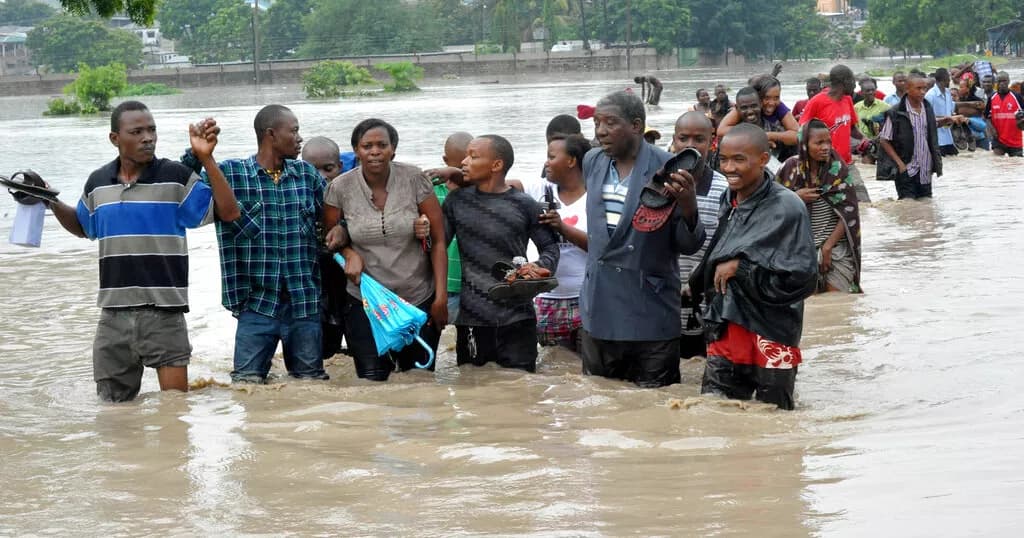
The rains began on December 26, 2025, two days after Christmas, in what should have been a normal rainy season bringing relief after months of drought.
Instead, they triggered one of Zimbabwe’s most destructive flooding episodes in recent years.
By early 2026, floods across Zimbabwe’s lowlands and river valleys had k!lled 70 people, injured 51 and destroyed more than a thousand homesteads. Schools, roads and bridges were washed away. Livestock perished. Fields planted with maize, the staple crop many families depend on for the year’s food supply, were submerged or swept away entirely.
Zimbabwe’s Civil Protection Unit recorded widespread damage in rural districts where seasonal bridges and basic drainage infrastructure could not withstand the intensity of the rainfall.
Across Southern Africa the disaster was even larger.
More than 200 people d£ad were recorded across Mozambique, South Africa and Zimbabwe combined. Around 173,000 acres of crops were destroyed and roughly 1.3 million people were displaced across the Southern African Development Community region.
Humanitarian agencies described the event as one of the region’s most significant weather driven displacements since Cyclone Idai devastated parts of Mozambique and eastern Zimbabwe in 2019.
Extreme rainfall overwhelmed rural infrastructure
Meteorological reports show that some areas experienced more than 200 millimetres of rain within a single 24 hour period.
Such rainfall would strain the drainage capacity of even modern urban infrastructure. In rural Zimbabwe, where many roads rely on seasonal bridges and culverts, the impact was immediate.
Floodwaters swept through villages along river systems including the Runde, Save and Lundi rivers.
Homes built from brick and pole structures were destroyed, livestock drowned and entire farming plots were washed away.
For communities that depend on subsistence agriculture, the loss of a single planting season can mean months of food insecurity.
Scientists confirm climate change intensified the floods
Climate researchers say the severity of the floods was not driven by La Niña alone.
The World Weather Attribution collective, an international group of scientists studying extreme weather events, analysed the rainfall patterns across Southern Africa and concluded that climate change significantly intensified the flooding.
Their research found that the natural La Niña weather cycle, which typically brings wetter conditions to southern Africa, was amplified by warming ocean temperatures linked to global greenhouse gas emissions.
Scientists say the warming of the Indian Ocean in particular increases the amount of moisture in storm systems reaching southern Africa.
That additional moisture makes heavy rainfall events more intense and more destructive.
A new pattern of extreme weather
Researchers warn that these events are not isolated disasters.
Climate models show that the interaction between recurring La Niña cycles and long term global warming will likely produce more frequent and more intense floods across the region.
Communities that once relied on relatively predictable seasonal rainfall patterns now face a far more volatile climate.
Traditional adaptation strategies that rural communities have used for generations were built around stable seasonal cycles.
The emerging climate pattern breaks those assumptions.
What happens next
The floodwaters have largely receded and humanitarian aid has stabilised the immediate crisis.
Families are returning to damaged homes or attempting to rebuild. Farmers are assessing whether replanting is still possible before the end of the rainy season.
But scientists say the broader threat remains.
Meteorological agencies are already monitoring the next La Niña cycle.
The climate conditions that amplified this disaster remain firmly in place.
Additional reporting sourced from World Weather Attribution and regional disaster reports. The Granite Post has independently verified key details.