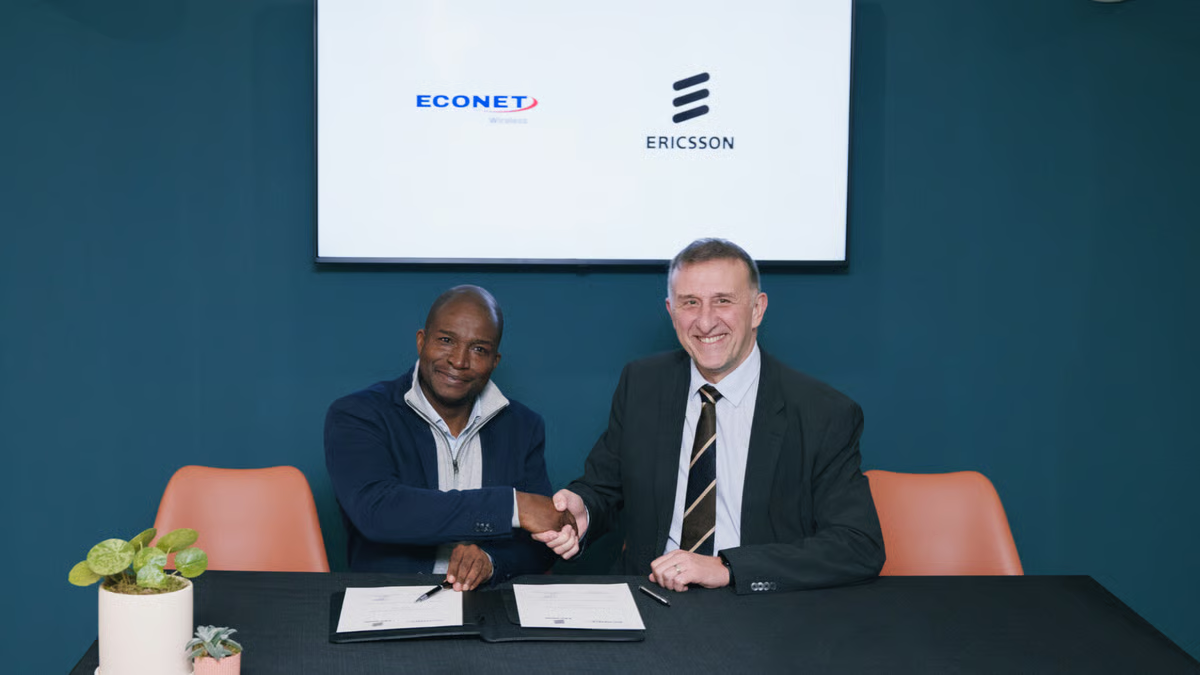
Ericsson and Econet Wireless Zimbabwe have signed a new agreement to test and deploy next generation mobile services in Zimbabwe, using Artificial Intelligence, 5G Advanced features and stronger network security, in a partnership announced at Mobile World Congress 2026 in Barcelona.
The Memorandum of Understanding sets up joint innovation work focused on improving network performance and reliability while cutting energy use, a critical cost line for mobile operators as demand rises and power constraints persist across the region.
What the MoU covers and what it actually means
The companies say initial work will focus on AI driven radio access network optimisation, 5G Advanced capabilities, exposed network APIs, network slicing and Internet of Things enabled services.
In practical terms, AI driven optimisation aims to help the network automatically tune itself to reduce congestion, improve coverage and lower energy consumption. Network slicing is designed to create separate virtual lanes on the same physical network, which can support services with different performance needs, such as emergency communications, enterprise connectivity or mass IoT deployments. Exposed network APIs allow approved developers and businesses to build services that interact with network capabilities more directly.
Energy efficiency is the headline, but the proof will be in rollout choices
Ericsson says it will work with Econet on network automation and energy performance, alongside energy efficient LTE and 5G solutions intended to reduce carbon footprint while expanding coverage and capacity.
The key question for customers will be where the first benefits show up. If optimisation targets the busiest corridors and base stations first, users may notice better speeds and fewer drops in major cities. If the focus moves quickly into rural coverage and backhaul upgrades, the impact could be broader but slower to measure.
How this fits Zimbabwe’s policy goals
The partnership is framed as supporting Zimbabwe’s National ICT Policy 2022 to 2027, with potential use cases in education, healthcare, enterprise services and industry digitalisation. For households and small businesses, the practical value will depend on whether improved coverage and reliability translate into lower data costs, better quality of service, and more stable connectivity for remote learning and e health.
What Econet and Ericsson said
Roy Chimanikire, Deputy Chief Executive Officer at Econet Zimbabwe, said the programme is aimed at improving performance while enabling new digital opportunities.
“This memorandum of understanding with Ericsson reflects our continued focus on evolving our network capabilities to meet growing customer expectations and national digital priorities.”
Roy Chimanikire, Deputy CEO, Econet Zimbabwe (as quoted by Ericsson)
Alain Maupin, Vice President and Head of Ericsson East and North Africa, said the work is intended to support programmable and more sustainable networks.
“Together with Econet Zimbabwe, we are advancing the evolution toward intelligent, programmable and more sustainable networks in the country.”
Alain Maupin, Vice President and Head of Ericsson East and North Africa (as quoted by Ericsson)
What the announcement does not answer yet
The MoU outlines technology areas, but it does not provide a public timeline for pilots, commercial launch dates, target provinces, or which customer segments will be first to receive new services. It also does not address spectrum plans, device readiness for 5G, or how network slicing and API access will be governed to protect consumer data and network security.
What happens next will be whether these trials produce measurable gains that Econet can publish, such as lower network energy consumption per gigabyte, fewer dropouts, higher peak speeds, or improved rural coverage benchmarks.
Additional reporting sourced from Ericsson. The Granite Post has independently verified key details.