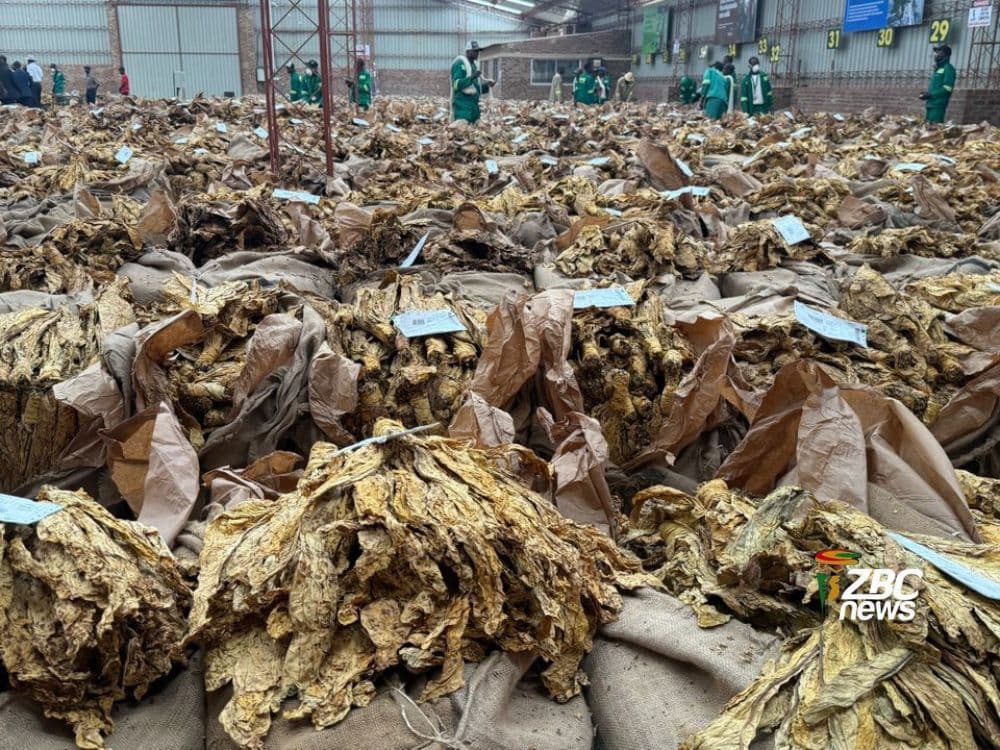
Tobacco contract floors have officially opened in Karoi, Mashonaland West Province, with prices surpassing US$5 per kilogramme, signalling a promising start to Zimbabwe’s 2026 tobacco marketing season.
Farmers from across Hurungwe District gathered at the auction floors following the nationwide opening of tobacco sales on March 4.
By Tuesday, contract floors were recording a top price of US$5.35 per kilogramme, a development that has boosted confidence among growers expecting improved returns this year.
Farmers Encouraged by Early Prices
Farmers attributed the encouraging prices to favourable rainfall patterns and the timely distribution of agricultural inputs, which enabled them to plant early and produce higher-quality tobacco leaf.
“This season we received good rains and managed to produce quality tobacco. The prices we are seeing at the auction floors are encouraging and we are hopeful farmers will realise good returns,” one grower said.
Farmers also welcomed the opening of contract floors closer to their farming areas, saying it reduces transportation costs for small-scale producers.
“We are happy that the auction floors have opened here in Karoi because it makes it easier for farmers to sell their crop without travelling long distances,” another farmer said.
Growers added that early access to farming inputs allowed them to plant on time, contributing to the improved crop quality seen this season.
Production Expected to Increase
The Tobacco Industry and Marketing Board (TIMB) says favourable weather conditions and increased farmer participation are expected to drive higher tobacco production this year.
TIMB regional manager Aid Taruvinga said Mashonaland West is projected to record improved output compared to last season.
“Last season Mashonaland West Province produced around 106 million kilogrammes of tobacco. This year we are projecting a harvest of between 112 million and 115 million kilogrammes,” Taruvinga said.
“This growth is largely driven by increased farmer participation, good rainfall patterns across most growing areas and the early distribution of inputs which allowed farmers to plant on time.”
Agritex Urges Farmers to Maintain Field Hygiene
Agricultural extension officials have urged farmers to observe recommended tobacco production practices to protect future harvests.
Mashonaland West provincial Agritex officer Evelyn Ndoro stressed the importance of destroying tobacco stalks immediately after harvesting.
“We encourage farmers to strictly follow tobacco production regulations, particularly the destruction of tobacco stalks after harvesting,” she said.
“Failure to destroy the stalks creates a breeding ground for pests and diseases such as tobacco aphids and viruses, which can significantly affect future crops.”
Ndoro said maintaining proper field hygiene is critical to protecting the sustainability of Zimbabwe’s tobacco industry.
Leaders Warn Against Environmental Damage
Magunje legislator Supa Monga Madiro called for increased awareness to curb veld fires and deforestation, warning that environmental degradation could threaten agricultural productivity.
“There is an urgent need to educate communities on the dangers of veld fires and deforestation,” he said.
“These practices are destroying forests and threatening the environment that supports agriculture and rural livelihoods.”
Government Pushes for Value Addition
Government officials say they are also focusing on value addition and local processing to maximise economic benefits from tobacco production.
Mashonaland West Minister of State for Provincial Affairs and Devolution Marian Chombo said decentralised tobacco processing could increase income opportunities for farmers and surrounding communities.
“Our plans going forward are to promote value addition of tobacco here in Karoi and other producing areas so communities benefit more from the crop beyond primary production,” she said.
“As decentralisation gathers momentum, we want to encourage local processing and other downstream activities that will enhance the value of tobacco while creating more economic opportunities.”
Hurungwe District remains one of Zimbabwe’s largest tobacco-producing regions, contributing nearly 30 percent of the country’s total tobacco output.
Reporting by Tamuka Charakupa | Adapted for Granite Post